An HR website that speaks to directors and individuals alike.
A director looking for support through a reorganisation and an employee planning a career change expect neither the same words nor the same proof. We build the site that welcomes both, each through their own door, without losing either one along the way.
Our reference in this industry
Dalina Conseil
HR consulting
What makes an HR firm look like just another vendor
You sell to two audiences who never talk to each other, on assignments you can barely describe. Here's where it breaks down, and where it gets fixed.
A director and an employee planning a career change read the same page
In the morning, a director is looking for someone who can take charge of a workplace climate that's deteriorating. In the afternoon, a manager is wondering whether they're allowed to stop everything and start over. Both land on the same home page, written to offend neither. The director doesn't see a peer capable of stepping into their organisation. The individual doesn't find anyone to talk to about their situation.
Your best work is the work you can't name
A reorganisation, a conflict that reached senior leadership, a negotiated exit, a redundancy plan: your strongest engagements are covered by the confidentiality you owe your clients. So the references page sits empty, or fills up with logos borrowed from somewhere else. An HR director who finds you sees neither the size of the organisations you work with, nor the kind of situations you know how to handle.
The funding question comes before the method question
Before they even write to you, someone considering a career assessment wants to know who's paying: their own training budget, their employer, a public funding scheme. On the company side, the question shows up differently, over which budget line and under which agreement. When the page says nothing about any of this, everyone lands on the same form, and you spend the first conversation explaining a funding process instead of talking about the assignment.
What proves you're credible ends up in the footer
Your accreditation, your certifications, the assessment tools you use, the years you spent inside HR before moving into consulting: these are exactly what a training or HR manager checks before they let you into a file. On most sites, they're tucked into a footer line or a PDF to download, exactly where nobody goes looking.
A site that holds both audiences
Each blocker gets its answer on the page, in the order the visitor asks the questions.
Two doors from the first screen
Companies on one side, individual journeys on the other, split from the home page onward. Each one follows its own path, with its own vocabulary, its own examples and its own proof, without having to read what's meant for the other.
Assignments told without being named
Industry, size of the organisation, the situation handled, what you delivered. We write up your work so an HR director recognises it, without ever surfacing a name you have to protect.
Funding laid out plainly
Which route funds which kind of support, in which case, with which documents to gather: it's written on the page. We don't file any paperwork on your behalf, we simply make what you already offer easy to read.
Your proof, moved to the top
Accreditation, certifications, your track record inside companies, assessment tools: everything moves to where people actually look for it. A training manager finds what they need to defend you internally without having to write and ask for it.
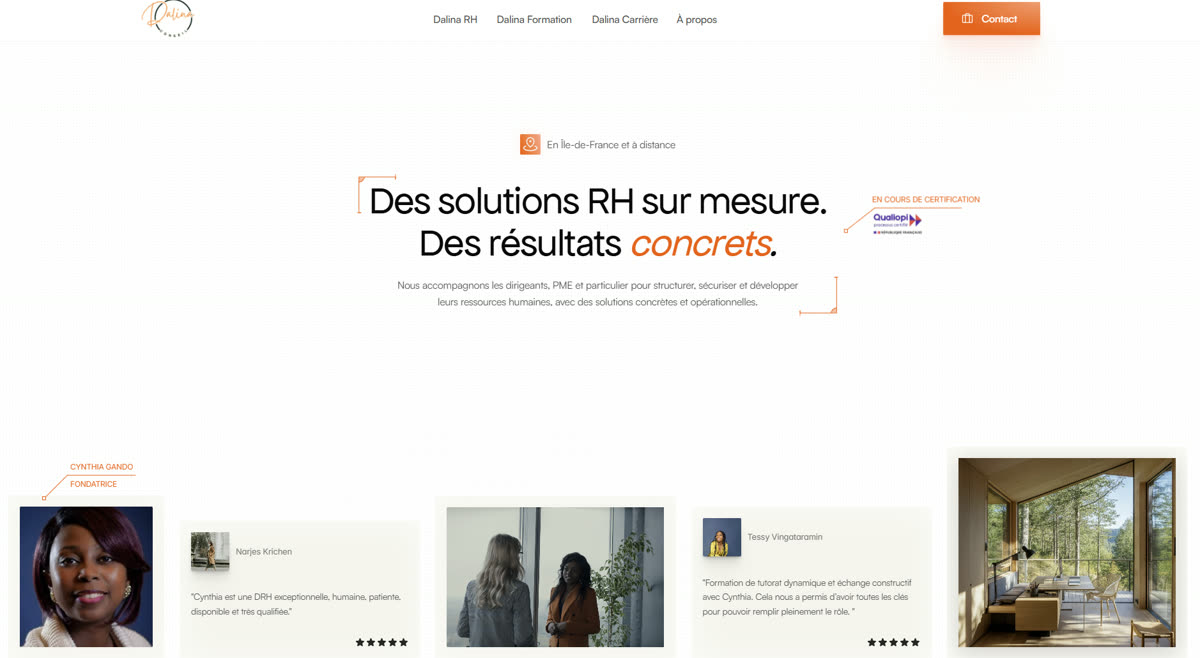
The redesign of Dalina Conseil
An HR consulting firm that supports directors and individuals alike. The case study shows the full site, with the before-and-after comparison, screen by screen.
Their words, not ours
Reviews translated from the original French.
A huge thank you to Matthis for the redesign of the DALINA CONSEIL website. Beyond the expertise, what struck me was how he listened, how invested he was, and how deeply he understood my world and my ambitions. A true professional, driven and involved. I recommend him without reservation.

Cynthia Gando
Founder, Dalina Conseil
From signature to launch
- 01
Signature
You sign the quote online and pay the deposit. The project starts.
- 02
Onboarding
We frame the whole thing in 20 minutes, then you get access to your client space: your project lives there from day one to delivery.
- 03
Visual direction
We show you the visual direction on your own home page. We rework it until you give it a clear yes.
- 04
Build
We build the other pages, we finish the details, then we put the site live.
Questions HR firms ask
My firm serves both companies and individuals. Do I need two sites?
One site, with two doors. Both activities share your name, your track record and your credibility: splitting them into two domains would force you to build everything twice and spread your visibility across two addresses. What we split is the journey. One door for companies, one for individuals, chosen from the first screen, each with its own pages, words and proof. The rest of the site serves both.
My assignments are confidential. How do I show my track record?
We work by type of assignment rather than by name. "Mid-sized industrial group, HR function overhaul after an acquisition" says more than a logo nobody recognises. When a client agrees to be named, we feature them with their quote. When they don't, the page still stands: it's the situation handled and the way it's told that makes the case, not the brand above it.
I offer career assessments. Do you handle funding applications and accreditation paperwork?
No, and it matters to say so before the call. We don't file your accreditation paperwork, we don't register you with funding bodies, and we don't deal with any funder on your behalf: that's your process, with your certifying body and your funders. What we do is make what already exists on your side readable on the site: which routes can fund which kind of support, what the person needs to prepare, where your accreditation number sits. A visitor who understands the process writes to you about their situation, not to ask who's paying.
How much does a website cost for an HR firm?
The amount depends on the scope: the number of pages, what needs writing, what already exists on your side. We price it after a first conversation, once we know what you actually need. You leave that call with a firm figure, not a range.
How long between signing and launch?
21 days on average. The timeline depends mostly on you: we need your feedback within 48 working hours. A firm that has a partner or associate review its copy should plan for one more week. That's normal, and we set that expectation at the quote stage rather than discovering it along the way.
Your firm speaks to two audiences. Your site can too.
Forty minutes on a call, no strings attached.
Check if we're a fitor write to us: matthis@rymav.studio