A tech company website that talks about the problem solved, not the stack.
A buyer discovers your name, opens your site, and looks for three things: what problem you solve, who it's for, and what the product looks like. We build the page that answers in that order, and structure it so Google and the AIs know how to cite it.
Our reference in this industry
NeuriaLabs
Artificial intelligence
What holds a good product back on its site
Four situations you'll recognise. None of them come from the technology: they all come from what the page says, or doesn't say.
Your home page talks about the product, not the problem
Architecture, models, infrastructure building blocks, integrations: everyone on your team can describe what got built. The buyer arrives with a different question. What problem you solve, for which role, and what it costs them. They read the first screen, don't find their situation in it, and go looking somewhere that names it. The page names no one, so no one recognises themselves in it.
The site was built by the people who write the code
It got put together in-house, between two sprints. The result is clean: it loads fast, it passes the tests, nothing breaks. But it reads like a documentation page, not a company you commit a budget to. Meanwhile, a funded competitor paid a studio. For an equivalent product, they're the one who looks solid, and they're the one who stays on the shortlist when the decision moves up a level.
The demo is locked behind a form
Your product makes sense in three screens, and those three screens sit behind 'Request a demo'. Someone who just discovered your name isn't ready to hand over their work email just to see what an interface looks like: they close the tab. The one who fills it in anyway shows up to the call not knowing what they're about to see, and you spend the first half of the meeting describing what a screenshot would have shown in three seconds.
You sell AI, and the AIs don't know who you are
A director looking for a solution no longer stops at Google: they ask ChatGPT or Perplexity who does this, then work off the list they're given. These engines lean on structured pages, clear-cut answers, and sources that corroborate each other. A company that sells artificial intelligence and shows up nowhere in these answers pays twice: it loses the lead, and it loses the argument.
Our answer, point by point
Each blocker has its answer on the page, in the order the buyer asks the questions.
We write the page in the buyer's words
The problem, the role it affects, what changes once the product is in place. The technology comes after, to back it up. We keep your exact terms, reordered the way people actually buy you.
We design a site that matches what you sell
Typography, palette, page rhythm, an interface shown with care. A visual direction chosen for your company, not a theme dropped onto a repo. Your site has to hold its own next to a funded competitor's.
We take the demo out from behind the form
Interface screenshots, use cases told in images, a journey you can see right on the page. The form stays for those who want to go further, it no longer guards the entrance.
We make you legible to search engines and to the AIs
Structure, markup, answers written to be picked up as-is: GEO gets built in at the design stage, not bolted on afterwards. We don't promise a spot in the answers, we put in place what makes it possible.
The site for NeuriaLabs
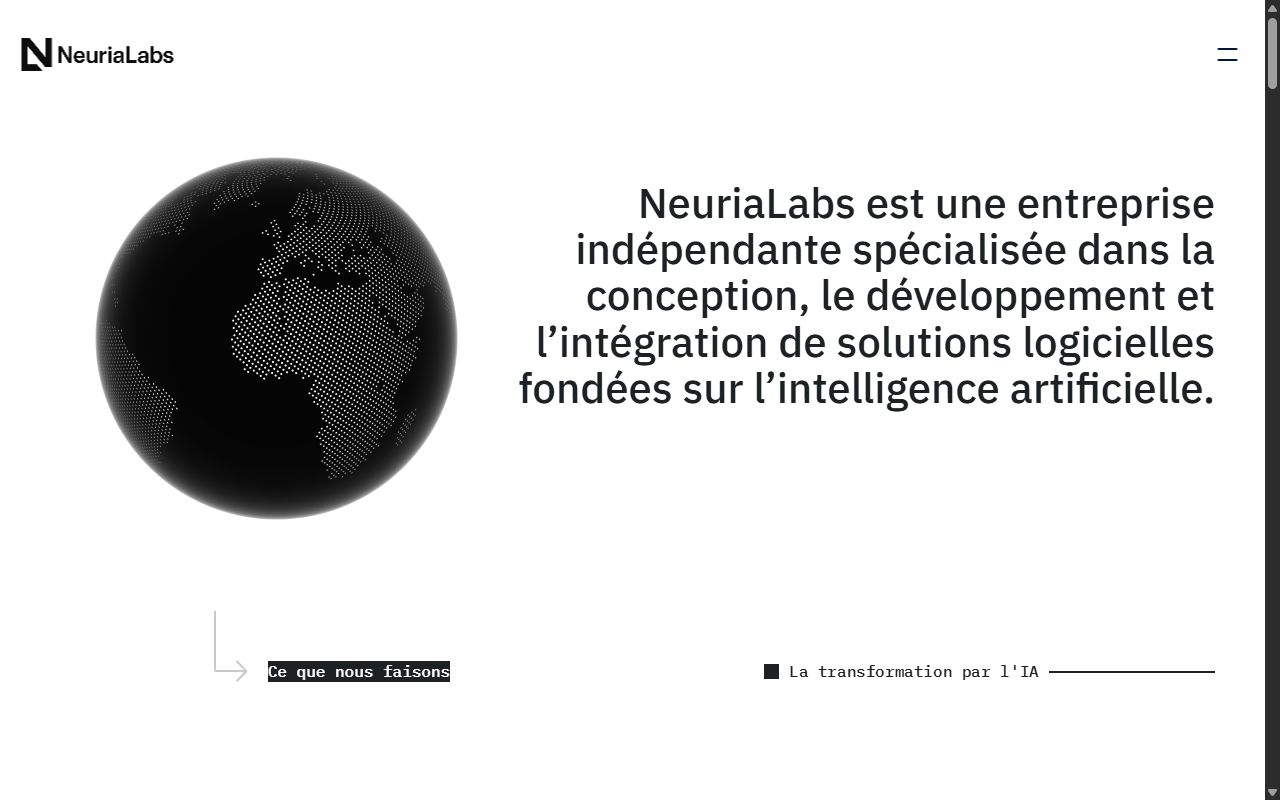
An independent company specialising in software solutions built on artificial intelligence. The site was built in 2025, across several pages. The case study shows the full site, from the first screen to the footer.
The client's review of this project
Reviews translated from the original French.
An outstanding professional: quick to answer, skilled and thorough. He built five sites for me in record time, with a level of quality beyond reproach. His efficiency and his technical command are remarkable, even on complex projects. Beyond the expertise, he listens closely and always comes back with a solution that fits. His professionalism, his seriousness and the speed at which he delivers make him a partner you can trust, and I recommend him without reservation. If you are looking for someone reliable, able to deliver a fast, well-built site on time, look no further: Matthis is the one you want.
TME Equipement
From signature to launch
- 01
Signature
You sign the quote online and pay the deposit. The project starts.
- 02
Onboarding
We frame the whole thing in 20 minutes, then you get access to your client space: your project lives there from day one to delivery.
- 03
Visual direction
We show you the visual direction on your own home page. We rework it until you give it a clear yes.
- 04
Build
We build the other pages, we finish the details, then we put the site live.
Questions tech teams ask
You're not a product development shop. Why hand our site to a design studio?
Because those are two different trades, and you're missing the second one. Rymav Studio builds sites: art direction, copywriting, page structure, SEO and GEO. We don't touch your product, we don't build applications, and we don't write your technical documentation. Your developers stay the only ones talking to your code. The site, on the other hand, speaks to someone who has never opened your interface and needs to understand in a few lines what you solve, and for whom.
Our positioning is still moving. Will the site be outdated in three months?
That's the real risk in this industry: the site stays frozen on the pre-pivot promise while the team has already moved on. So we build the pages so you can change a headline, a promise, a product page or a use case without calling us. You get a handover session and a dedicated guide. The structure also takes on extra pages, a new offer, or a blog, without rebuilding the site from scratch.
Concretely, what makes a site citable by ChatGPT or Perplexity?
Three things, all handled at the design stage. A structure a machine can read: hierarchical headings, structured data, pages that each cover one topic. Answers written to be picked up as-is, stated plainly, right where the question is asked. And consistency between what your site says and what the other sources talking about you say. We don't sell any guaranteed placement: the field is young and nobody controls these answers. You can measure your starting point with our free audit before you even talk to us.
How much does a website cost for a tech company or a software vendor?
The amount depends on the scope: the number of pages, what needs writing, what already exists on your side. We price it after a first conversation, once we know what you actually need. You leave that call with a firm figure, not a range.
How long between signing and launch?
21 days on average. The timeline depends mostly on you: we need your feedback within 48 working hours. At a tech company, it's usually the interface screenshots and getting product terminology approved that take the longest, because several people tend to have an opinion on it. We set that expectation at the scoping stage rather than discovering it along the way.
Your product deserves a page that says what it changes.
Forty minutes on a call, no strings attached.
Check if we're a fitor write to us: matthis@rymav.studio