A training provider website that fills your cohorts.
Three things get decided on your site, in this order: whether your organisation is credible, whether this course is the right one, and when the next cohort starts. We build the pages that answer all three, for the learner and for the employer sending them.
Training providers and trainers have trusted us with their site
Money Trees
Sales closing and setting training
Altermedic
Naturopathy school
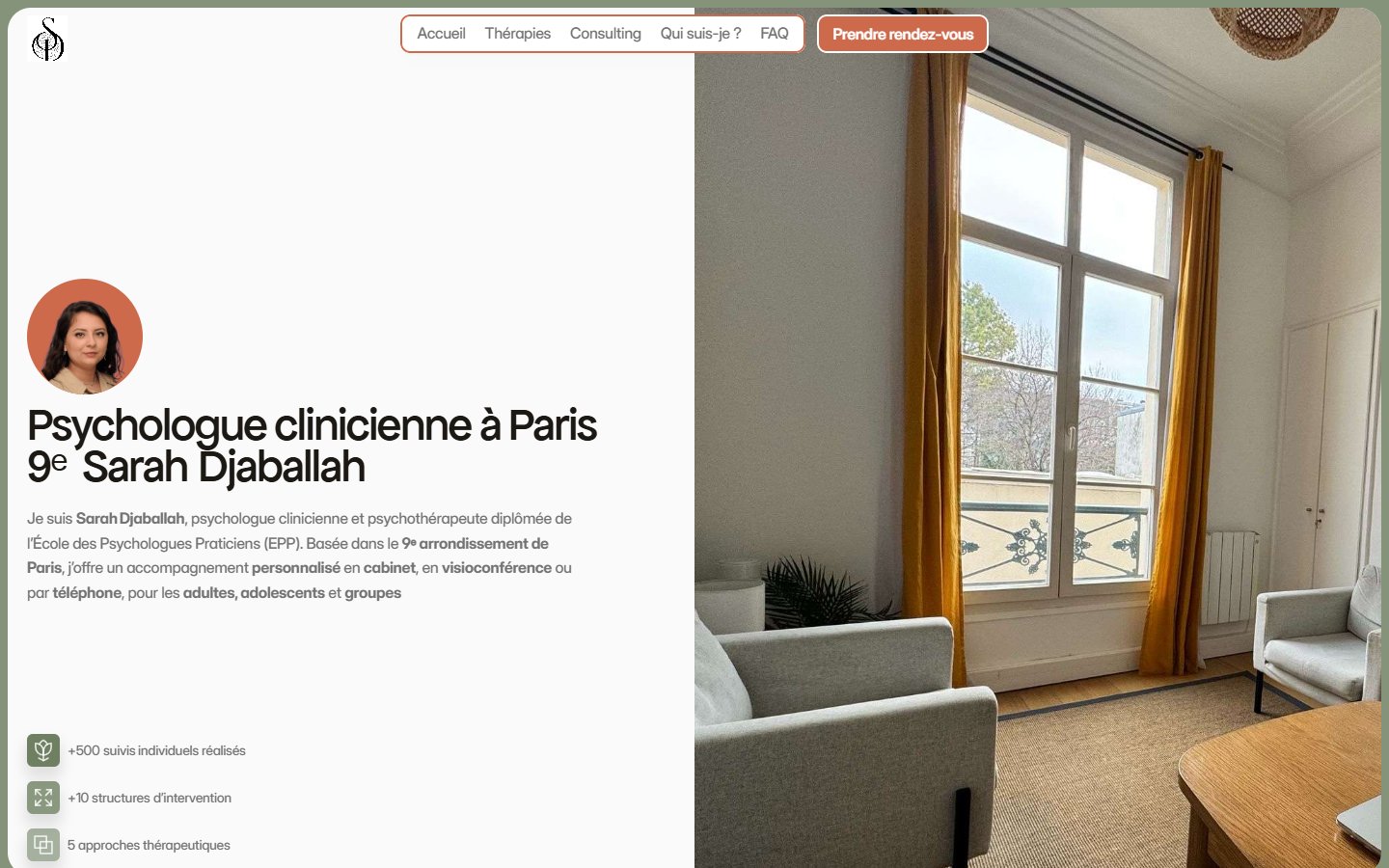
Sarah Psy Paris
Psychologist and trainer
QualiCie
Consultant and trainer
What costs a training provider sign-ups
Five blockers that show up at one provider after another, whatever the subject taught. None of them come from your teaching: they all come from what your pages say, or don't say, to someone comparing you against another provider.
Your catalogue is a list, not a pathway
Your courses sit stacked on a page, in the order they were created. Whoever lands there doesn't know your internal naming: they don't know if the introductory module is enough, whether they need to take two courses back to back, or what separates them from the next level up. Faced with a list they can't read, they do one of two things. They write and ask which one is for them, and you answer by hand. Or they do nothing.
A course page doesn't say what you need to know before signing up
Open one of your course pages and read it as someone discovering your organisation for the first time. You'll find a syllabus, modules, titles. You won't find who it's for, what you need to know coming in, what you can do coming out, or what it costs in time: how many days, at what pace, in person or remote, with how much work between sessions. These are exactly the points people decide on.
Accreditation and funding are treated like a legal footnote
Your accreditation, your certifications, your approval with funding bodies: all of it lives in small print, down near the legal notice. And yet it's the first question asked, by the learner who wants to know if their course can be funded, and by the HR manager who has to justify the budget line. Pushing what actually triggers the request down to the footer means letting people walk away who were ready to sign up.
Two audiences arrive, one message waits for them
The individual paying out of pocket wants to know what the course changes for their future and how they can pay for it. The company sending six people wants a syllabus, logistics, a point of contact and a quote. One piece of copy can't serve both. Written for the first, HR has nothing to circulate internally. Written for the second, the individual feels like they've landed somewhere that doesn't work with people like them.
No date, so nothing to decide today
Nowhere on the site can you see when the next cohort starts, where it runs, or whether there's still room. So there's nothing to decide right now: the visitor notes your name, tells themselves they'll look later, and later never comes. A visible date does what a 'Contact us' button never will: it turns a vague intention into a sign-up with a real date attached.
Our answer, point by point
Each blocker has its answer on the page, in the order the learner and their employer ask the questions.
We replace the list with guidance
We enter the catalogue through the learner's situation and level, not through your internal structure. Everyone reaches the course that concerns them without reading the whole catalogue, and sees what comes before, what comes after, and what the neighbouring pathway covers.
We rewrite every course page
Who it's for, what you need to know beforehand, what you can do afterwards, the length, the pace, the format, how it's assessed. We start from your existing syllabus and turn it into a page a prospective learner can read, not an auditor.
We move accreditation to where people look for it
Accreditation, certifications, approved funders: these move out of the footer and land where the question is actually asked. On the course page, right before the form, and on the page HR will circulate internally to get the spend approved.
We separate the individual's path from the company's
Two doors, two styles of writing, two forms. One leads to an individual sign-up, the other to an in-house session request with everything an HR team needs to get it approved internally.
We make your cohorts visible and your pages findable
Dates, locations, format, remaining spots: a cohort calendar you open and close yourself, without coming back to us. Alongside that, we structure the site for Google and for the AIs, at the design stage rather than as an afterthought. We don't promise any ranking, we put in place what makes it possible.
Do you also bill consulting work alongside your courses? Our page for consultants and consulting firms covers that case.
Three ways to sell a course
A training agency built entirely for conversion, a school recruiting its cohorts, a practitioner who trains alongside her practice. Each project has its own case study: the full site, from the first screen to the footer.

Two clients in this industry
Reviews translated from the original French.
The work delivered is of a very high standard. Responsiveness, professionalism, thoroughness and care are the strong points of Rymav Studio. He met my demanding expectations and my many requests. I recommend his work and wish his company great success. Thank you again!

Sarah Djaballah
Founder
To give you my feedback, I am really happy

Mendy Cassou
Founder
From signature to launch
- 01
Signature
You sign the quote online and pay the deposit. The project starts.
- 02
Onboarding
We frame the whole thing in 20 minutes, then you get access to your client space: your project lives there from day one to delivery.
- 03
Visual direction
We show you the visual direction on your own home page. We rework it until you give it a clear yes.
- 04
Build
We build the other pages, we finish the details, then we put the site live.
Questions training providers ask
You're not training specialists. How will you write about our programmes?
We don't rewrite the substance for you. Rymav Studio builds sites: art direction, page copy, catalogue structure, SEO and GEO. We don't do instructional design, we don't write your course materials or your quality documentation, and we don't touch the content of your training itself. What we take on is turning your programmes, often written in an administrative format, into pages someone still on the fence about signing up can actually read.
Our catalogue changes every year. Will we need to call you for every update?
No. You add a course, edit a syllabus, open a cohort or close one, without us. You get a handover session and a dedicated guide at the end of the project. The structure takes on extra pages, a new course family or a blog, without rebuilding the site from scratch.
How do you handle accreditation and funding without putting us at risk?
We display what's true on your side, in your words and backed by your own documentation, and nothing else. We don't write any funding rule on the site that you haven't approved, we don't stand in for your compliance contact, and we don't spell out schemes that keep changing: a page that talks too much about this ages badly and puts you at risk. What we build is the place where the question comes up, a clear answer, and the path to whoever handles that side of things on your team.
Can the site connect to our platform or our enrolment tool?
We connect what's connectable: a form that lands in your inbox or your CRM, a link to your platform, a cohort calendar you keep up to date yourself. What we don't do is build a platform, build your learner portal, or write a connector between two pieces of software. If your tool exposes a link or a form, we integrate it cleanly into the journey. If what you need is the development work itself, that's not our trade, and we say so on the first call.
How much does a website cost for a training provider?
The amount depends on the scope: the number of courses to present, what needs writing, what already exists on your side, whether there's a separate company track or not. We price it after a first conversation, once we know what you actually need. You leave that call with a firm figure, not a range.
How long between signing and launch?
21 days on average. The timeline depends mostly on you: we need your feedback within 48 working hours. At a training provider, it's usually the course pages that take the longest, because they need a version that speaks to someone new to the subject, and several people tend to have an opinion on it. We set that expectation at the scoping stage rather than discovering it along the way.
Your next cohort fills up on a page.
Forty minutes on a call, no strings attached.
Check if we're a fitor write to us: matthis@rymav.studio